

Learn the differences between SOC and PCI compliance for hosting providers and how they impact...
AWS vs. Azure vs. Concourse Private Cloud: A Performance and Cost Comparison


Choosing between AWS, Azure, and Concourse Private Cloud depends on your workloads, budget requirements, and how much infrastructure complexity you want to manage. This comparison examines all three platforms across four critical vectors: architectural performance, total cost of ownership, security governance, and operational support.
For organizations running mission-critical Windows and SQL Server workloads, the differences between these platforms are substantial. While AWS and Azure excel at cloud-native development and global content distribution, Concourse Private Cloud delivers faster SQL performance with more predictable costs for steady-state database applications.
We've spent a decade hosting SQL Server environments for healthcare providers, universities, and nonprofits. This article shares what we've learned about where each platform performs best, so you can make an informed decision for your organization.
Why Organizations Are Moving Away from Public Cloud
The "Cloud First" mandates of the past decade are giving way to "Cloud Smart" strategies. Organizations that migrated everything to AWS or Azure are now selectively moving workloads back to on-premises or managed private environments.
According to industry research, up to 80% of organizations are investigating or executing workload repatriation strategies. This shift reflects a maturing understanding of cloud economics rather than a rejection of cloud computing.
The core issue: public clouds charge premium prices for optionality that steady-state workloads don't need. A transactional database running 24/7 with predictable utilization doesn't benefit from the ability to scale from one server to ten thousand in seconds. That optionality has a cost, and many organizations are questioning whether they should keep paying it.
The "Rent vs. Buy" Economics
Public cloud pricing follows a "pay for what you use" model. For variable workloads, this makes sense. For consistent workloads, the math changes quickly.
A SQL Server database that runs at 70% capacity 24/7 will cost significantly more on hourly cloud billing than on dedicated infrastructure. Add egress fees, premium storage tiers, and enterprise support contracts, and the total cost often exceeds on-premises or private cloud alternatives.

How Cloud Architecture Affects SQL Server Performance
Performance differences between cloud platforms come down to hardware engineering decisions. Understanding these differences helps explain why the same application can perform differently across AWS, Azure, and Concourse Private Cloud environments.
Compute Processing and Clock Speed
Microsoft SQL Server uses a core-based licensing model. This creates an important cost dynamic: slower processors require more cores to achieve the same throughput, which means higher licensing costs.
Public Cloud Approach
AWS and Azure optimize their processors for power efficiency and data center density. Standard instances run on processors with variable clock speeds, and customers have little control over which specific hardware their workload lands on.
To achieve required SQL Server throughput, you might need to provision 16 vCPUs on a standard instance. That means 16 cores of licensing costs.
Concourse Private Cloud Approach
Purpose-built private cloud environments can standardize on high-frequency processors optimized for database workloads. For example, Intel Xeon Gold processors running at 3.6GHz deliver more work per core than lower-frequency alternatives.
This means fewer cores required, which translates directly to lower SQL Server licensing costs while maintaining or exceeding the transaction throughput of larger public cloud instances.
Storage Latency: NVMe vs. Network-Attached Storage
SQL Server is an I/O-intensive application. High storage latency causes "I/O Wait" states where the CPU sits idle, waiting for data. This directly impacts query performance and application responsiveness.
How Public Cloud Storage Works
In AWS and Azure, storage is typically network-attached. When an EC2 instance writes to an EBS volume, data traverses the data center network to a separate storage array. This network hop introduces latency.
To overcome this, users must upgrade to premium tiers:
- AWS: Upgrade from gp3 to io2 Block Express for sub-millisecond latency and high IOPS guarantees
- Azure: Use Ultra Disk, which creates a complex billing matrix based on provisioned capacity, IOPS, and throughput
How Concourse Private Cloud Storage Works
Concourse Private Cloud deploys NVMe (Non-Volatile Memory express) storage connected via high-speed fabric. This architecture delivers sub-millisecond latency as standard rather than as an expensive add-on.
The absence of multi-tenant "noisy neighbor" effects, where another customer's data warehouse query saturates the storage controller, ensures consistent latency for user-facing transactional systems.
Network Architecture and Bandwidth
Network throughput affects data replication speeds, backup performance, and end-user response times.
In public clouds, bandwidth is often capped based on instance size. A small SQL Server instance on Azure might have a hard cap on network throughput (for example, 500 Mbps), creating a hidden bottleneck unrelated to CPU or RAM.
Concourse Private Cloud offers dedicated network allocations without artificial caps based on instance tier.
The True Cost of Cloud Infrastructure
The sticker price of cloud computing rarely reflects the total cost. Understanding the complete pricing picture requires examining several categories of charges.
Data Egress Fees: The Hidden Cost
Data egress, the cost of moving data out of the cloud, is one of the most criticized aspects of public cloud pricing. It creates billing volatility and acts as vendor lock-in.
AWS Egress Pricing: rates vary by which source and destination regions
- Data Transfer OUT to Internet: approximately $0.09 per GB after the first 100GB
- Data Transfer Inter-Region: $0.02 to $0.09 per GB
- Data Transfer Inter-AZ: $0.01 per GB
Real-World Example
A healthcare provider retrieving 50 TB of medical imaging data per month would pay approximately $4,500 monthly in egress fees alone, before compute and storage costs.
Azure follows similar pricing structures. Both platforms make it cheap to get data in but expensive to get it out.
Concourse Private Cloud includes data transfer in pricing
Microsoft Licensing Considerations
The interaction between cloud infrastructure and Microsoft licensing adds another layer of complexity.
AWS: Running Windows on AWS includes licensing costs that are typically higher than on-premises equivalents since AWS must pass on licensing costs without Microsoft's bundling benefits.
Azure: Microsoft incentivizes Azure adoption with the Azure Hybrid Benefit, allowing customers to bring existing on-premises licenses to the cloud. This makes Azure generally cheaper than AWS for Windows workloads.
Concourse Private Cloud: Using Service Provider License Agreements (SPLA), Concourse bundles OS and SQL licenses into monthly service fees. When combined with high-frequency processors that require fewer core licenses, the total licensing cost is often lower than both AWS and Azure.

Security and Compliance Comparison
Security responsibility differs fundamentally between public clouds and Concourse Private Cloud.
The Shared Responsibility Model
AWS and Azure operate under a shared responsibility model. The provider secures the physical infrastructure. The customer secures everything inside it.
This means customers must:
- Configure firewalls and security groups
- Manage OS patches and updates
- Encrypt data at rest and in transit
- Configure Identity and Access Management
- Monitor for threats and intrusions
Misconfiguration is the leading cause of cloud breaches. A single misconfigured S3 bucket or security group can expose an entire organization.
Concourse Private Cloud assumes more security responsibility. The PRISM™ Security Framework includes continuous monitoring, threat detection, and proactive security management rather than just providing tools for customers to configure.
Infrastructure Segmentation: Rings of Resilience vs. DIY VPCs
How you segment and protect different parts of your infrastructure matters significantly for both security and disaster recovery.
Public Cloud Segmentation
In AWS and Azure, creating proper security segmentation requires designing complex VPC architectures, subnet configurations, and security group rules. Customers must:
- Design and implement their own network topology
- Configure VPC peering for multi-environment setups
- Manage security groups across development, staging, and production
- Document and maintain their segmentation strategy
This complexity often leads to shortcuts. Many organizations run everything in a single VPC with minimal segmentation, creating larger blast radius when incidents occur.
Concourse's Rings of Resilience Approach 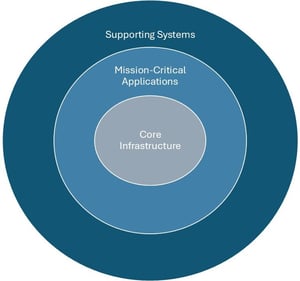
Concourse uses a "Rings of Resilience" framework that maps and segments your environment based on criticality:
- Ring 0: Core infrastructure (Active Directory, domain controllers, identity systems)
- Ring 1: Mission-critical applications and databases
- Ring 2: Endpoints and replaceable systems
This framework ensures that your most critical systems receive the highest protection levels, while also informing disaster recovery priorities and security monitoring focus. Each ring receives appropriate isolation through dedicated VLANs, subnets, and firewall rules.
The difference: instead of customers designing their own segmentation strategy (and often doing it poorly), Concourse implements proven segmentation based on what actually matters to your business continuity.
HIPAA and PCI DSS Compliance
For healthcare and finance organizations, compliance is non-negotiable.
All three platform types can achieve HIPAA and PCI DSS compliance, but the burden differs significantly.
Public Cloud Compliance
AWS and Azure will sign Business Associate Agreements (BAAs), but their coverage is limited to infrastructure. Customers remain responsible for application security, access controls, encryption configuration, and audit documentation.
Concourse Private Cloud Compliance
Concourse Cloud is HIPAA/HITECH compliant and PCI DSS Level 1 certified. The managed service scope means BAAs cover more of the operational stack, reducing the customer's liability surface area.
The difference shows up clearly during audits. An audit-ready stance with proactive documentation support contrasts with self-service compliance artifacts.
Support Models and Database Expertise
The hidden cost of the public cloud is talent. Managing an AWS or Azure environment at scale requires specialized cloud architects and DevOps engineers who command premium salaries.
Public Cloud Support
AWS and Azure support is tiered and priced separately. AWS Enterprise Support starts at $5,000 per month.
Lower tiers often route to generalist support queues with variable response times and expertise.
When you call AWS support with a SQL Server performance issue, you're likely speaking with someone who knows AWS infrastructure but not necessarily the specifics of SQL Server tuning.
Concourse Private Cloud Support
Concourse includes support in base pricing with named technical account managers who know your specific environment.
The difference becomes clear at 2 AM when your database is throwing errors. Generic infrastructure support differs substantially from engineers who understand both your platform and your application.
From client feedback, we've learned this matters. As one client described it: "It isn't 'hey, you guys figure it out,' it's 'hey, let's work together to get to the answer.'"
That collaborative approach isn't something you can purchase as a support tier upgrade.
AWS vs. Azure vs. Concourse Private Cloud: Full Comparison
|
Factor |
AWS |
Azure |
Concourse Private Cloud |
|
Best For |
Cloud-native apps, serverless, global distribution |
Microsoft-centric shops with Azure Hybrid Benefit |
Steady-state SQL Server, Windows and Linux workloads |
|
Performance Model |
Variable (noisy neighbor effects) |
Variable (noisy neighbor effects) |
Consistent (dedicated resources) |
|
SQL Server Optimization |
Customer responsibility |
Customer responsibility |
Provider-managed tuning |
|
Egress Fees |
$0.09+/GB |
$0.087+/GB |
Included as part of hosting fee |
|
Storage IOPS |
Paid separately |
Paid separately |
Billed monthly on set rates |
|
Security Model |
Shared responsibility |
Shared responsibility |
Managed responsibility |
|
Support |
Tiered pricing, generalist |
Tiered pricing, generalist |
Included, specialized |
|
Cost Predictability |
Variable monthly bills |
Variable monthly bills |
Fixed monthly pricing for compute and network services |
|
Compliance Burden |
Customer manages |
Customer manages |
Provider manages more of stack |
Which Platform Should You Choose?
The right choice depends on your workloads and organizational priorities.
When AWS or Azure Makes Sense
Public clouds remain the best choice for:
- Cloud-native development: Applications built on serverless functions, containers, and microservices
- Global content delivery: Workloads requiring edge caching across hundreds of geographic regions
- Extreme elasticity: Scenarios requiring rapid scaling of thousands of instances for short-term processing
- Development and testing: Environments that spin up and down frequently
- Modern SaaS applications: Native integrations with cloud ecosystem services
If your workload profile includes significant variability, or burst requirements public cloud pricing often makes economic sense.
When Concourse Private Cloud Makes Sense
Concourse Private Cloud is typically the better fit for:
- Modern SaaS applications: Native integrations with cloud ecosystem services
- Mission-critical Server databases running at consistent utilization
- Regulated industries (healthcare, finance) where compliance burden matters and the Rings of Resilience segmentation approach provides clear audit trails for how critical systems are protected
- Organizations lacking specialized cloud staff to manage complex public cloud configurations
- Workloads with high egress requirements where data movement costs add up quickly
- Applications requiring consistent, predictable performance without noisy neighbor effects
- Budget-conscious enterprises seeking predictable OpEx over variable cloud bills
The pattern we see repeatedly: organizations that moved "everything to the cloud" are now selectively bringing their most critical systems of record back to purpose-built environments while keeping variable workloads in the public cloud.
Making the Right Decision for Your Infrastructure
The question isn't "which platform is best" but "which platform is best for this specific workload."
"For core systems of record running on SQL Server, the combination of performance consistency, predictable costs, managed security with built-in segmentation, and reduced operational burden makes Concourse Private Cloud worth evaluating. For cloud-native applications and variable workloads, AWS and Azure deliver capabilities that specialized providers can't match.
Most organizations end up with a hybrid approach: mission-critical databases on dedicated infrastructure, with development environments and variable workloads on public cloud platforms.
If you're evaluating options for your Windows, SQL Server, and Linux hosting workloads, we're happy to share what we've learned from hosting these environments for the past decade. Schedule a conversation to discuss your specific requirements and see whether a purpose-built approach makes sense for your organization.
*This post was researched and drafted with the assistance of AI. All posts undergo Concourse team input and full human review, including link and fact-checking, to ensure content is accurate and meets Concourse's editorial standards.