By 2026, the question for most organizations is no longer whether to move to the cloud. Instead, it’s where each workload belongs.
Rising cost pressure, operational fragility in distributed architectures, regulatory hardening around data sovereignty, worsening data gravity, talent constraints, and the accelerating force of AI have converged into the most consequential cloud decision inflection point in over a decade. The organizations that will thrive are those that align their workloads to the right cloud model, not the most popular one.
Across the industry, the pressure is visible:
- Worldwide spending on public cloud services is expected to double from 2024 to 2028 (IDC).
- Only 8% of organizations qualify as highly mature in their cloud practices — meaning the vast majority struggle with complexity and operational burden (HashiCorp).
- By 2028, 25% of organizations will report significant dissatisfaction driven by multi-cloud failure modes, outages, and governance gaps (Gartner).
Cost, complexity, and compliance are rising at the exact moment AI is intensifying computing demands and data gravity. In short: 2026 requires a reality check about where workloads should live, and what “cloud resilience” truly means.
This article examines how Public, Private, Hybrid, Multicloud, and Community Cloud models function in 2026, provides a decision matrix, and maps common scenarios to the right path. It concludes with why organizations with sensitive workloads, uptime requirements, or VMware displacement pressures are turning toward a governed, single-tenant private cloud foundation.
Cloud Deployment Options in 2026: What Each Model Really Provides
The cloud landscape has matured dramatically, and each deployment model now serves a more specific purpose than it did even a few years ago. Below is a practical breakdown of what each model offers in 2026, including a quick description followed by the real strengths and limitations organizations should consider.
Private vs. Public vs. Hybrid Cloud in 2026
A. The Private Cloud
A private cloud delivers dedicated infrastructure—owned or managed—isolated for a single organization. Unlike shared hyperscaler infrastructure, private clouds provide full control over configuration, segmentation, and performance. Managed private cloud offerings, like the one Concourse delivers, pair that control with 24×7 operations, proactive monitoring, and enforced governance.
Strengths
- Maximum control & governance
A private cloud provides dedicated infrastructure where organizations control configuration, segmentation, and security.
- Data residency & sovereignty
A governed private cloud environment can guarantee data location — increasingly relevant for government, healthcare, and enterprise compliance frameworks.
- Predictable performance & throughput
No noisy neighbors. No multi-tenant contention. Dedicated compute ensures stable performance and tighter SLAs.
Limitations
- Talent requirements
Operating a private cloud requires specialized SRE, virtualization, security, and compliance expertise.
- Capex predictability vs. cash flow
Organizations trade variable public cloud OPEX for infrastructure lifecycle management — unless working with a managed provider such as Concourse.
B. The Public Cloud
The public cloud is built and operated by hyperscalers like AWS, Microsoft Azure, and Google Cloud. Organizations rent compute, storage, networking, and managed services on-demand within a shared, multi-tenant environment. In 2026, the public cloud remains the fastest way to gain access to global scale, GPU-rich AI platforms, and highly automated developer ecosystems.
Strengths
- Elasticity & on-demand scale
Hyperscalers (AWS, Azure, Google Cloud) remain unmatched in burst capacity, serverless compute, global CDN reach, and rapid provisioning.
- Global services & modern AI/ML toolchains
If you need managed LLM APIs, turnkey analytics, or ephemeral GPU clusters, the public cloud delivers immediate access.
- Developer experience & rapid innovation
Best-of-breed PaaS services, mature IaC tooling, and frictionless dev/test environments make the public cloud the fastest place for experimentation.
Limitations
- Cost instability & poor predictability
Metered compute. Variable IOPS costs. Storage classes with unpredictable retrieval fees. Licensing surprises. 83% of CIOs say they overspent their cloud budgets by an average of 30% (Azul).
- Data egress charges & data gravity acceleration
Moving data out of cloud ecosystems — especially for analytics or AI pipelines — can be punishingly expensive.
- Multi-tenant performance variability
Shared networks, noisy neighbors, and unpredictable latency can undermine SLAs for mission-critical systems.
- Operational fragility
Several headline-making outages in 2025 underscored the hard truth: when a hyperscaler’s shared control plane fails, everyone fails together.
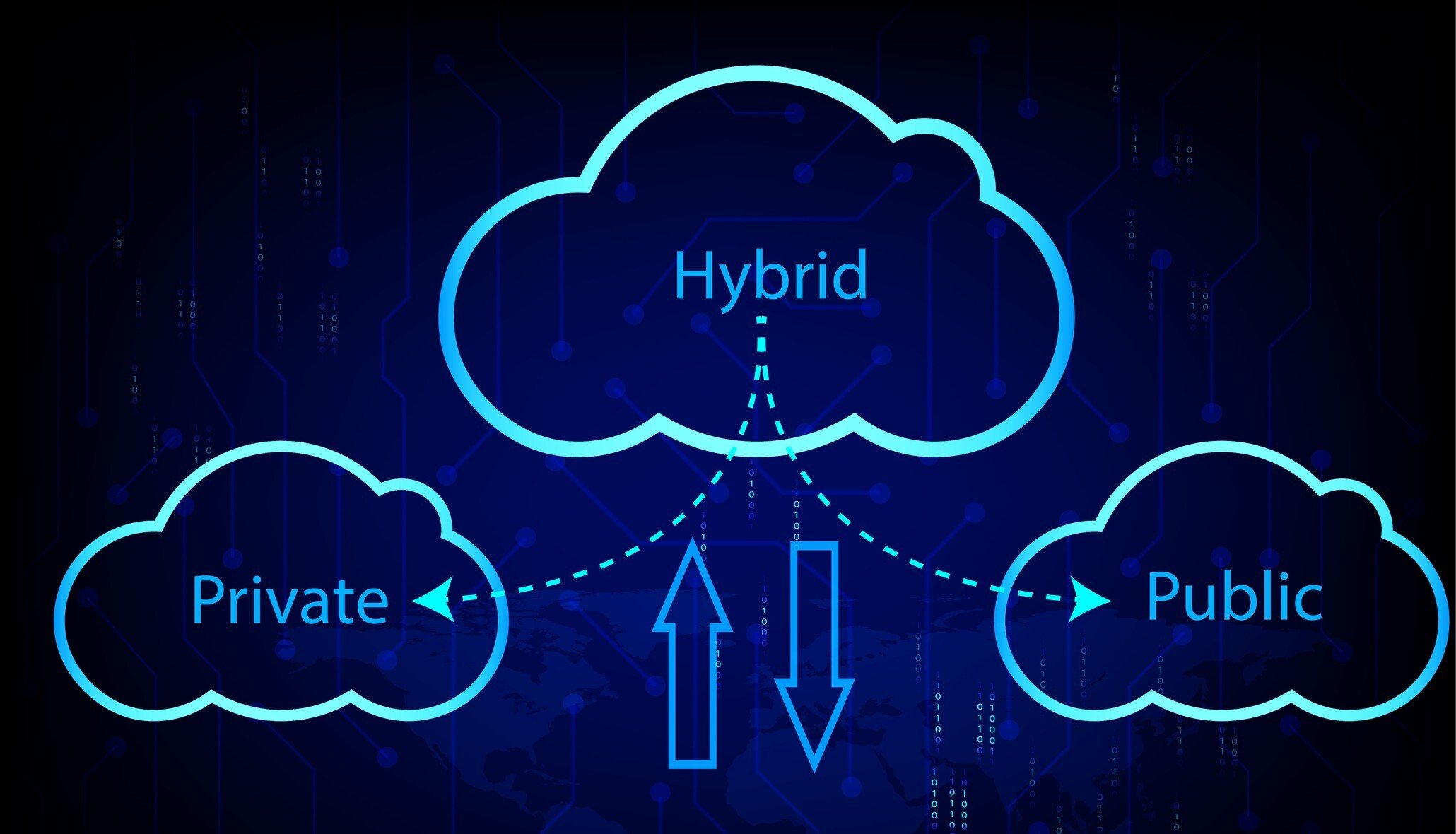
C. Hybrid Cloud (The 2026 Reality Version)
Hybrid cloud has finally matured into a clear architectural pattern: one governed private cloud for identity and mission-critical workloads, connected to one public cloud for elastic and modern services. The goal isn’t to “mix everything everywhere”—it’s to place each workload where it performs best, while keeping governance unified.
Strengths
- Right workload → right platform
Mission-critical, identity-centric, and regulated data stay in a hardened private cloud; elastic or replaceable systems expand into public cloud.
- Regulatory alignment
Hybrid models allow organizations to isolate sensitive workloads while still leveraging public cloud innovation.
Limitations
- Operational overhead
Managing identity, DR, patching, and policy across two worlds introduces complexity.
- Governance fragmentation
Multiple security models and auditing standards must be reconciled.
- Tool inconsistency
Monitoring, automation, and DevOps workflows often diverge unless intentionally unified.
Supplemental Cloud Models for Specialized Needs
Strengths
- Vendor independence — reduce lock-in
- Choose best service per cloud — analytics, AI, storage, edge
- Resilience through ecosystem diversification
Limitations
- Significant operational complexity across identity, networking, observability
- Highest talent and tooling burden
- Higher cost from duplicated platforms and skillsets
- More complicated governance requirements
A community cloud is a shared environment built for organizations with identical compliance requirements—commonly seen in healthcare, education, government, or nonprofit sectors. While more controlled than public cloud, it still involves multi-tenancy and shared governance.
Strengths
- Shared compliance baseline for regulated groups
- Standardized controls and operating models
- More predictable than public cloud for regulated workloads
Limitations
- Less flexible than private cloud
- Scaling limitations due to shared design
- Governance overhead — multiple organizations, shared responsibility
- Still multi-tenant — which may not meet isolation requirements for sensitive workloads
Comparison Table: Tradeoffs Across Cloud Models
|
Criterion
|
Public Cloud
|
Private Cloud
|
Hybrid Cloud
|
Multicloud
|
Community Cloud
|
|
Cost
|
Variable, unpredictable
|
Predictable, lifecycle-bound
|
Mixed
|
High
|
Mid-range
|
|
Control
|
Low
|
High
|
High for core workloads
|
Mixed
|
Medium
|
|
Compliance & Governance
|
Moderate
|
Strong
|
Strongest when designed well
|
Complex
|
Strong
|
|
Performance & Data Gravity
|
Variable; egress expensive
|
Predictable
|
Balanced
|
Fragmented
|
Predictable
|
|
Agility
|
Highest
|
Moderate
|
High when unified well
|
High but complex
|
Moderate
|
|
Talent Requirements
|
Cloud engineering
|
SRE, virtualization
|
Highest
|
Highest
|
Moderate
|
|
AI Readiness
|
Best for managed AI
|
Strong
|
Hybrid access
|
Strong but complex
|
Limited
|
Decision Paths by Scenario

Scenario 1 — Steady-State Workloads
Many organizations run long-lived, predictable workloads that don’t flex with traffic and don’t benefit from the elasticity (or cost variability) of the public cloud. These workloads typically underpin core business operations—ERP systems, financial databases, authentication services—and disruptions or performance swings can cause widespread business impact. In 2026, the biggest challenge isn’t hosting them—it’s ensuring these systems remain predictable in an increasingly unpredictable cloud environment.
Priorities:
- Stable, consistent performance
- Predictable and controllable cost
- High uptime and reliable recovery
- Clear governance and auditability
Best fit: Private Cloud, or Hybrid with private as the anchor environment
Rationale:
Steady-state workloads don’t need metered burst capacity—they need consistency. A single-tenant private cloud eliminates noisy neighbors, multi-tenant variability, and egress-related cost surprises. Hybrid models allow organizations to keep the crown jewels isolated while using public cloud for surrounding application layers if needed.
Scenario 2 — Modernization (Containers, Service Mesh, Refactoring)
Organizations modernizing legacy applications—moving toward microservices, container platforms, and modern CI/CD pipelines—often rely heavily on public cloud ecosystems to accelerate development. The challenge is avoiding a modernization path that unintentionally ties core systems into a fragile, multi-tenant environment or forces identity and data into services that later become cost or compliance constraints.
Priorities:
- Modern tooling for developers (Kubernetes, serverless, pipelines)
- Ability to experiment quickly without infrastructure delays
- Scalable environments for test/stage workloads
- Protecting sensitive or identity-centric workloads during modernization
Best fit: Hybrid Cloud, with modernization occurring in public cloud and core systems remaining private
Rationale:
Public cloud provides unmatched velocity for development and refactoring. But regulated or mission-critical systems shouldn't be rebuilt directly inside multi-tenant environments where outages or data gravity can create future constraints. A hybrid approach enables the best of both worlds: public cloud for innovation, private cloud for governance and control.
Scenario 3 — VMware Exit / Cost Shock
Licensing changes, support restructuring, and increased pricing following the VMware acquisition have pushed many organizations into urgent reevaluation mode. What used to be a stable, predictable virtualization layer has rapidly become one of the most volatile cost centers in IT.
Priorities:
- Predictable cost structure
- Continuity and stable performance
- Reduced licensing or platform dependency
- Minimal disruption during migration
Best fit: Private Cloud, or Hybrid with private as the primary control plane
Rationale:
A managed private cloud allows organizations to move off VMware without incurring public cloud metering, egress charges, or multi-tenant risk. V2V migration paths allow workloads to shift into a hardened, dedicated environment with far more predictable performance and cost. Adding hybrid capability enables organizations to modernize at their own pace rather than rushing into public cloud rewrites.
Scenario 4 — Regulated Workloads
Organizations in healthcare, government, education, finance, and nonprofits often handle sensitive data—PHI, PII, donor records, financial data, citizen services—that operate under strict regulatory oversight. Public cloud can offer compliant frameworks, but shared environments create challenges for segmentation, audit readiness, and incident containment.
Priorities:
- Strict data residency and privacy guarantees
- Segmentation and isolation of critical systems
- Clear audit trails and compliance evidence
- Guaranteed uptime and controlled recovery paths
Best fit: Private Cloud, or Hybrid with regulated workloads isolated in private cloud
Rationale:
Many regulatory frameworks expect organizations to demonstrate meaningful isolation and minimized lateral movement risk—both of which are difficult to achieve in shared, multi-tenant environments. A single-tenant private cloud provides clean auditability and strict segmentation, while hybrid models allow public cloud to support non-regulated or user-facing systems without increasing risk.
Migration & Motion Models (2026 update)
Most organizations in 2026 are not moving everything to a new platform at once. Instead, they use a combination of migration “motions” based on workload sensitivity, modernization goals, cost pressures, and regulatory constraints. The following models represent the most common and effective paths.
Rehost (“Lift and Improve”)
What it is:
Move workloads as-is into a more controlled environment, with minimal changes.
Best for:
- Rapid stabilization
- Urgent public-cloud cost reduction
- VMware exit deadlines
- Workloads that need higher uptime or segmentation immediately
Why it matters in 2026:
Rehosting has re-emerged as a first step for reducing hyperscaler cost unpredictability, regaining governance, and containing risk before modernization.
V2V (Virtualization-to-Virtualization)
What it is:
Migrate virtual machines from one hypervisor to another with minimal refactoring.
Best for:
- Organizations exiting VMware
- Consolidating fragmented virtualization estates
- Reducing licensing costs or platform dependency
Why it matters in 2026:
The shift in VMware’s licensing model and support structure has pushed thousands of mid-market and enterprise organizations toward alternative virtualization stacks. V2V provides a controlled, low-disruption way to land these workloads in a new environment.
Replatform (Container Shift)
What it is:
Move applications to modern runtimes—containers, Kubernetes, service mesh—without fully rewriting them.
Best for:
- Teams adopting DevOps or GitOps workflows
- Organizations standardizing on Kubernetes
- Applications that need increased portability or autoscaling
- Hybrid environments where dev/test is in public cloud and prod is private
Why it matters in 2026:
Container adoption is now a modernization baseline, especially for organizations preparing to integrate AI/ML services or needing consistent environments across hybrid architectures.
Refactor (Microservices + AI Augmentation)
What it is:
Rewrite or break apart applications for modularity, resilience, observability, and integration with AI services or models.
Best for:
- Custom, revenue-critical applications
- Systems needing better resilience or event-driven design
- Workloads integrating AI augmentation, RAG pipelines, or inference services
- Long-term modernization roadmaps
Why it matters in 2026:
AI-readiness is now a modernization driver. Refactoring enables applications to take advantage of AI-based automation, prediction, classification, and workflow orchestration without being limited by older architectural patterns.
Replace (SaaS Adoption)
What it is:
Retire legacy or undifferentiated apps and transition to SaaS platforms.
Best for:
- Commodity workloads (HRIS, ticketing, CRM if compliance allows)
- Aging or heavily customized on-prem systems
- Organizations wanting to reduce management overhead
Why it matters in 2026:
SaaS has matured dramatically, but regulated sectors must still evaluate data residency, multi-tenancy, and reporting requirements. Replacement reduces operational burden but cannot be used for workloads needing strict isolation or custom logic.
Why Organizations Choose Concourse
In a 2026 cloud landscape defined by cost volatility, hyperscaler outages, tightening regulations, and widespread VMware uncertainty, Concourse stands out as a governed, single-tenant private cloud built for organizations that cannot afford shared-infrastructure risk. Concourse provides the control of on-prem infrastructure with the agility of cloud and the simplicity of a concierge-level managed service.
Organizations turn to Concourse when they need:
Security-First Architecture (PRISM Framework)
Organizations facing rising threats, compliance pressure, and multi-tenant risk need an environment purpose-built for isolation and proactive defense, not just passive security tooling.
Concourse delivers this through the PRISM Security Framework, which includes:
- Palo Alto Networks firewalls and network segmentation
- Rubrik immutable backups with locked, undeletable data
- CrowdStrike endpoint protection and threat intelligence
- Cloudflare global edge security and DDoS protection
- Private VLANs, subnets, and firewalls by default
- Data physically and logically isolated—never co-mingled with other tenants
- Aligned with PCI DSS 4.0 principles across environments
Why it matters:
This creates a defense model that actively contains threats, eliminates lateral movement, and provides continuous visibility across all layers—something multi-tenant clouds fundamentally cannot replicate.
Enterprise-Level Reliability for Critical Workloads
When identity, authentication, and core business systems must never go down, organizations need more than availability zones—they need layered, independent resilience.
Concourse provides:
- Always On SQL Server Availability Groups (2-node active/passive)
- No performance impact from backups or DBCC
- Immutable backups every 15 minutes with verified restore
- Rapid failover and segmented network rings that limit blast radius
Why it matters:
This architecture maintains uptime even through kernel bugs, ransomware events, or hyperscaler outages.
Predictable, Transparent Cost and Performance
Private cloud should not mean variable performance or unpredictable spend.
Concourse ensures:
- Right-sized dedicated hardware with no metered compute
- No egress fees or unpredictable IOPS charges
- Pure Storage FlashArray//X (NVMe) for sub-millisecond latency
- Fewer, faster cores with double RAM for optimized SQL throughput
- Intelligent workload isolation for consistent performance
Why it matters:
This removes the cost chaos and performance variability common in public cloud and multi-tenant environments.
Operational Clarity and High-Touch Human Support
Organizations with regulated, complex, or mission-critical workloads need more than a ticketing system—they need a partner who understands their environment end-to-end.
Concourse provides:
- Dedicated Technical Account Managers who know your environment intimately
- High-touch support, not a helpdesk queue
- Proactive guidance and observability through the Concourse Portal
- 24×7×365 emergency response
- Formal incident response and service catalog
- Environment-specific optimization (SQL Sentry + certified SQL DBA team)
Why it matters:
This eliminates the fragmented support model common in hyperscale and MSP environments and provides a true single point of accountability.
Fast, Low-Risk Migration and Modernization Paths
Organizations cannot afford multi-year transformation projects—or migrations that introduce new risk.
Concourse supports:
- V2V migrations in weeks for VMware exit
- Lift-and-improve rehosting to immediately stabilize cost or performance
- Phased modernization using containers, Kubernetes, and hybrid placement
- Automation and AI-ready foundations powered by Windmill
- Future-proof architecture built for next-gen workloads and agentic AI integration
Why it matters:
Organizations can move out of vulnerability quickly—then modernize at their own pace, without committing prematurely to public cloud refactoring.
Your Resilience Review (Recommended Next Step)
Concourse offers a complimentary, two-week resilience review — an engineering-led deep dive into your infrastructure, security posture, governance model, and workload placement.
This includes:
- Assessing your compute, identity, segmentation, and Disaster Recovery (DR) capabilities
- Providing a phased modernization and migration roadmap
- Recommending the right placement across private, hybrid, and public cloud
- Delivering a clear path toward a governed, single-tenant private cloud foundation
No tools to buy. No fees. No obligations.
Final Thought: Getting Cloud Right in 2026
Public cloud gives you reach.
Private cloud gives you control.
Hybrid cloud gives you balance.
But resilience — the ability to withstand outages, breaches, egress spikes, regulatory shocks, and AI-era data gravity — requires more than a deployment model. It requires governance, segmentation, observability, uptime guarantees, and single accountability.
Big Cloud has delivered the illusion of resilience. Concourse builds the real thing.
Ready to explore what real resilience looks like?
Contact us to start the conversation.
*This post was researched and drafted with the assistance of AI. All posts undergo Concourse team input and full human review, including link and fact-checking, to ensure content is accurate and meets Concourse's editorial standards.